Overview
Coding dojo bootcamp cohort were tasked to create and collaborate a hypothetical product with Chicago Scholars REACH. We were given two months to conduct research, interviews with Chicago Scholars networking schools, and to present our product to the Chicago Scholars REACH board.
Higher education organizations are not investing in their REACH Platform.
What is REACH?
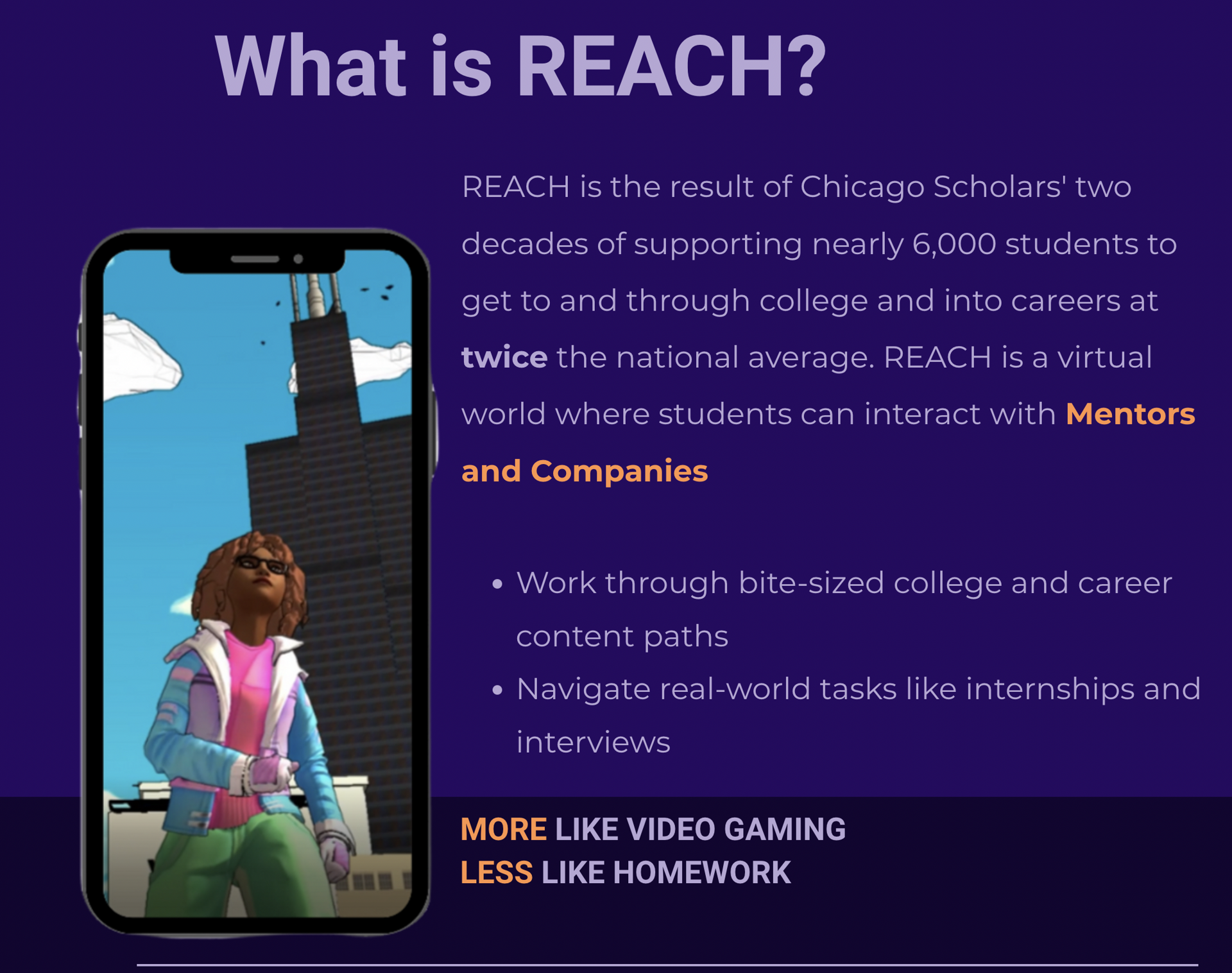
REACH is a college and career pathway of the nexus of companies and communities. Reach is a virtual world where students can REACH mentors, jobs, guidance, and community at their fingertips. Less like schoolwork and more like a video game, REACH provides fun and rewarding pathways to college and career.
THE GOAL
Improve how higher education staff can provide support for their students.
THE SOLUTION AND IMPACT
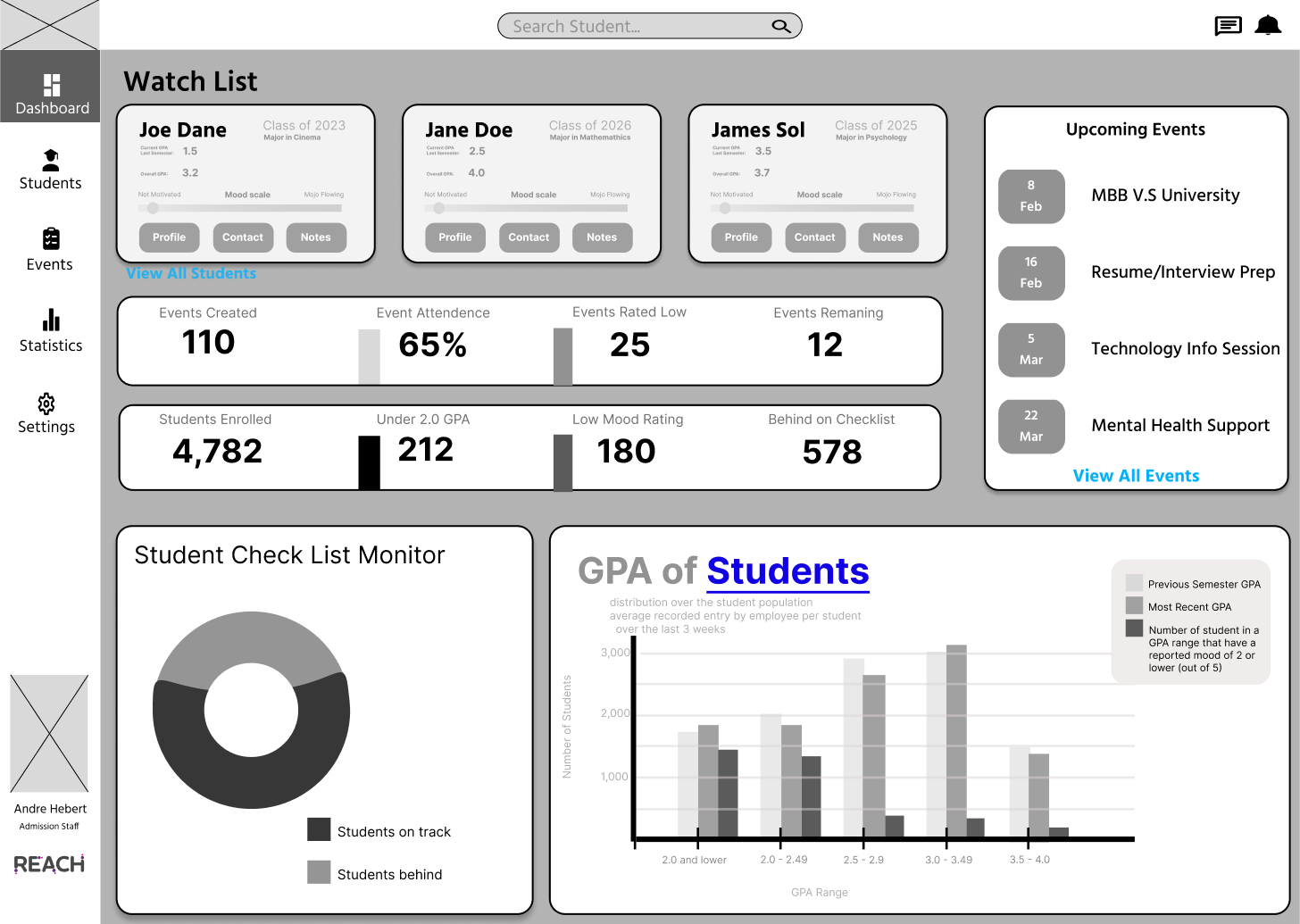
A dashboard that provides functionality and features to assist staff with providing purposeful support to their students and this is the result we made.
My Role
I led the conduction of interviews, designer meetings, and research for the first month of the project. I collaborated with two other designers in the research and interviews.
I led the final visual designs for the dashboard and designer meetings after three more designers were added into our team for the second month of the project.
Research
Competition to Chicago Scholars REACH Program were nonexistent. Majority of products or applications that could compare mainly focused on making friends with their fellow students. Nothing has surfaced with a product that schools provide a central hub of support the schools provide on their campuses. This encouraged the team to focus on user interviews with students and staff with the lack of competition.- Admission Recruiters 66%
- Communication Strategist 17%
- Students 17%
- What is the competition doing?
- How do schools currently promote support to their students?
Conceptual Development

”I want to arm students with the tools they need to succeed. I don’t believe in gatekeeping. I don’t believe school should be a survival of the fittest situation.” - Fareine Suarez
Fiona was inspired by Fareine Suarez’s college admission recruiter for Illinois Institute of Technology, quote and dedication for every student to have equal chances for success. Other interviewees also shared equal motivation of providing every tool necessary for students to succeed academically and personally. Higher education staff persona was a unanimous decision from the team because majority (83%) of our interviewees shared that similar profession.
What can solve Fiona’s problem? I suggested that we use a dashboard because it could be filled and organized with any feature Fiona would need. We all agreed a dashboard felt the most appropriate solution because it allows customization with relation to the users liking. I suggested that the team perform a 6-8-5 Sketching exercise for more concrete discovery on the product.
Aaron
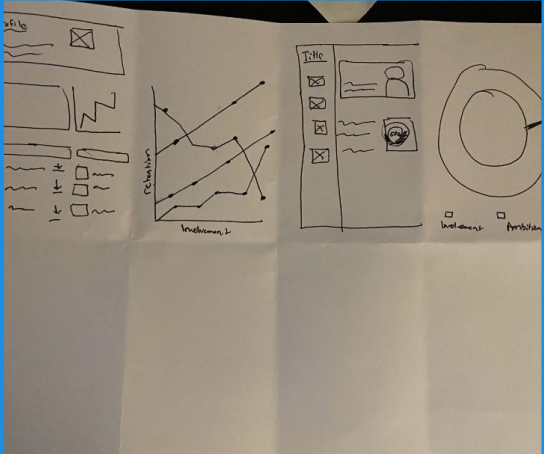
Isaac
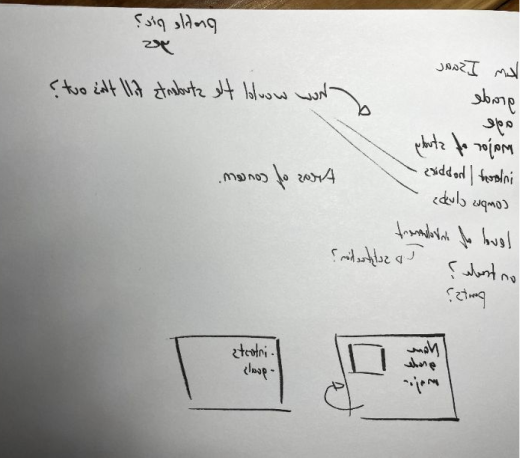
Demetrius
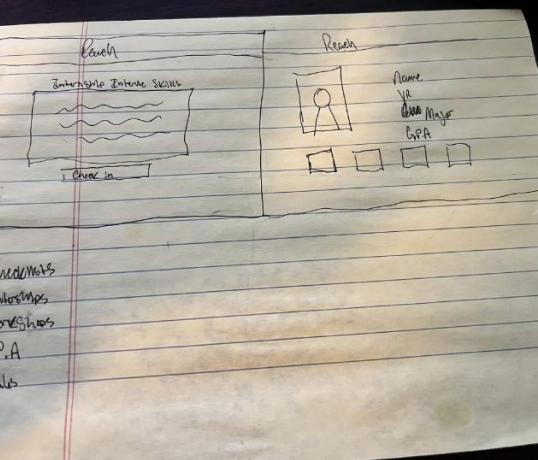
Janelle
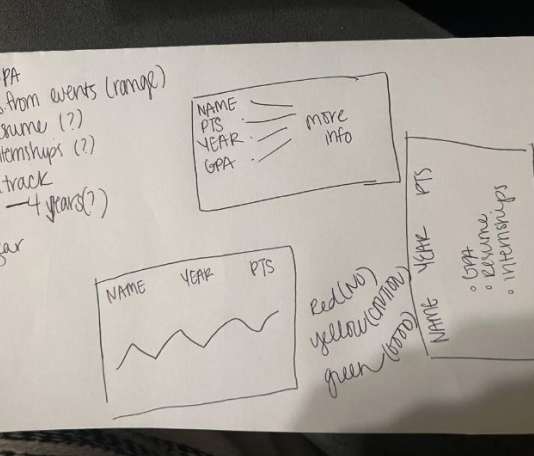
Final Product & Development
It was obvious with our sketches that cards were a focal point on the dashboard. The first iteration of the card was constructed by our team member Issac. I felt the card was crowded and the information presented redundancy. I changed the card to have less features and consistent structure.I decided to combine several buttons on the bottom because their functions were going to same place. I decided to locate students’ class year and major on the top right to perfectly line up with the name for it to be scannable. I made the fonts larger for identifying and important information so it doesn’t go unnoticed.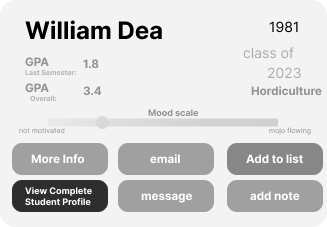
Before
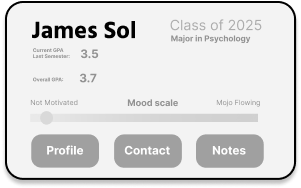
Final
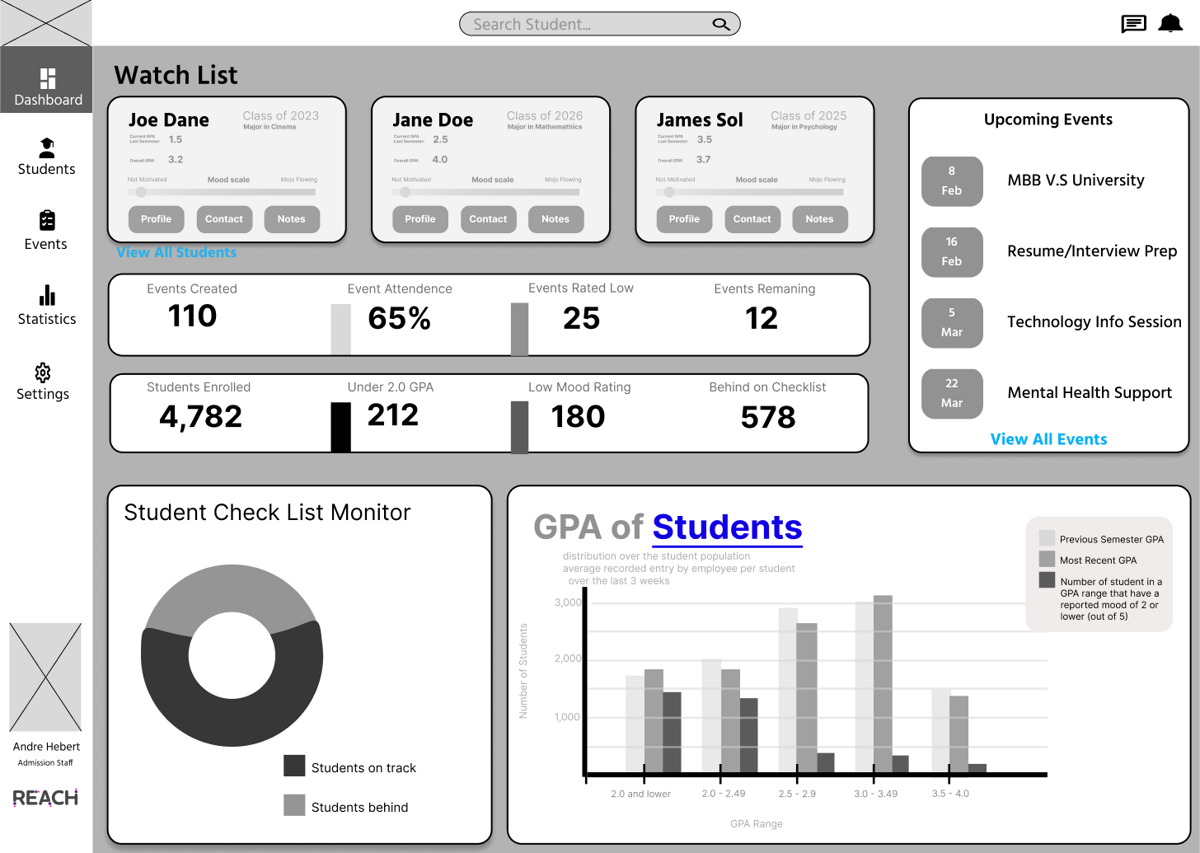
Final Dashboard
After finishing the initial dashboard, I encouraged our team to create a student profile page because we had the extra time and it will assist us on further questions that could come up in our presentation.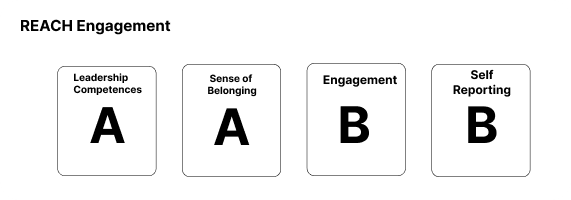 I contributed on adding the feature of showing letter grades for students engagement with the REACH platform. Tying in the business owner’s product into the student profile felt necessary. It shows the client how they can check in on their students within the virtual reality. Potentially giving a tangible reason for investing into REACH.I also decided the structure and spacing for the student profile. I wanted information to have enough space to be scanned and completely visualized with quality information.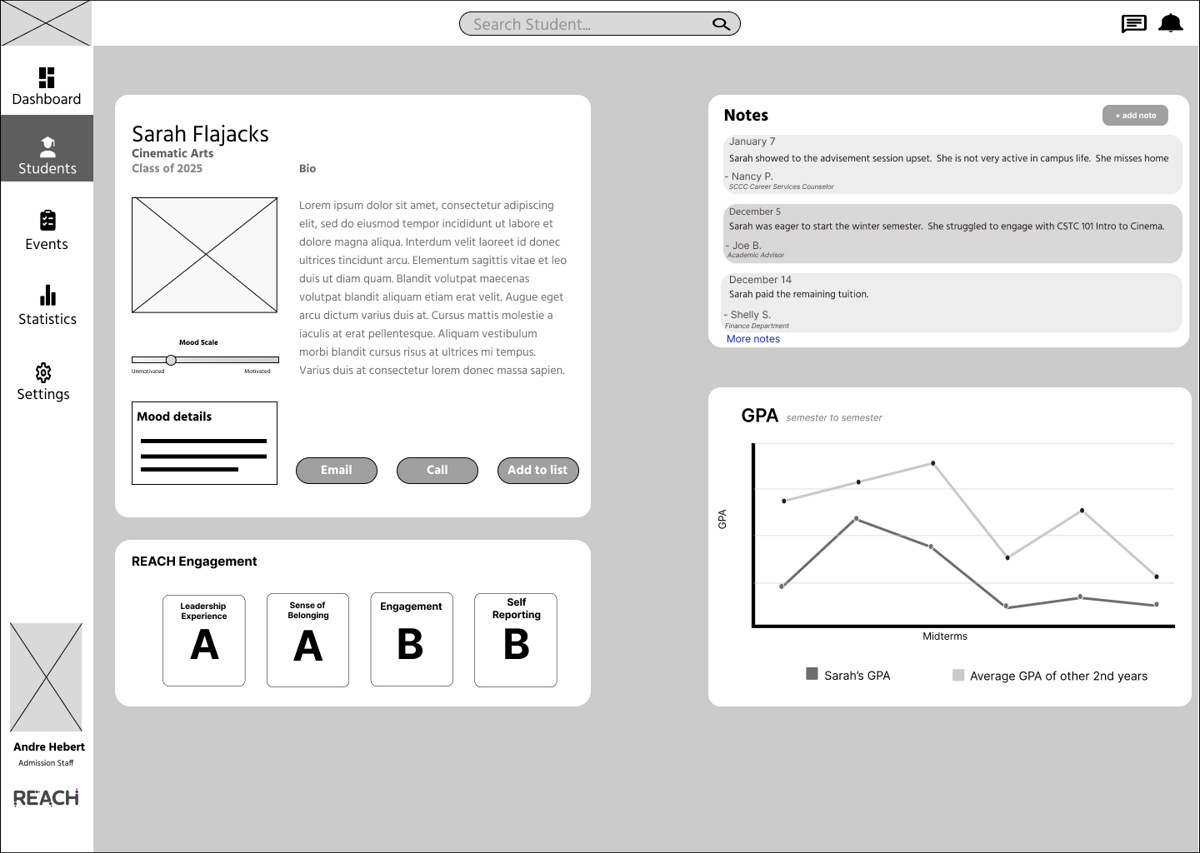
Final Product of Student Profile
What’s Next
The client loved our idea and was thankful on how it opened their eyes for new possibilities and who to communicate with to further advance our solution. We were aware that there was more we could have done if we had more time.One of the first steps we would take would be to perform more user interviews. We had a limited interviewee base to further discoveries and validations of our design. We can merely speculate on what we thought the user needs were with our persona Fiona. We would have hoped to discover what we were missing and did right in order to create an impact with our design.
Finally we would have focused on the students and generate a dashboard specifically for them. We mainly focused on our higher education user base because our client resonated with our problem statement stated earlier with Fiona. Knowing what benefits the students would in turn benefit the higher education staff. It would give us more clarity on what components they should have with relation to the students.